Selecting the right lithium polymer (LiPo) battery is one of the most important decisions when developing a drone. The battery affects not only flight time, but also thrust response, payload capacity, overall weight, power-system compatibility, and operational reliability.
However, choosing a battery based on capacity or C-rating alone can lead to unexpected performance issues. A battery with a larger capacity may add too much weight, while a high-discharge battery may not provide the endurance required for long-duration missions.
For drone manufacturers, UAV developers, and FPV brands, the goal is to find a battery that balances power output, energy density, weight, dimensions, and reliability.
In this guide, we explain seven key specifications to consider when selecting a LiPo battery for your next drone project.
1. Battery Voltage and Cell Configuration
Battery voltage must match the electrical requirements of your drone’s motors, electronic speed controllers (ESCs), and other power-system components.
LiPo batteries are commonly described by their cell count, represented by the letter “S.”
For standard LiPo cells, the nominal voltage is approximately 3.7V per cell, with a typical maximum charging voltage of 4.2V per cell.
Common configurations include:
- 4S: 14.8V nominal
- 6S: 22.2V nominal
- 8S: 29.6V nominal
- 12S: 44.4V nominal
Higher-voltage configurations can help meet the power requirements of certain drone platforms, but the appropriate configuration depends on the motor system, ESC limits, and overall aircraft design.
Engineering tip: Confirm the permitted voltage range of every relevant component before selecting a battery configuration.
2. Capacity: How Much Energy Does Your Drone Need?
Battery capacity, measured in milliamp-hours (mAh) or amp-hours (Ah), indicates how much electrical charge a battery can store.
A higher-capacity battery can potentially support longer operation, but capacity alone does not determine actual flight time.
Increasing capacity usually adds weight. That extra weight may require more thrust and increase power consumption, reducing some of the expected endurance benefits.
When selecting capacity, consider:
- Required flight time or mission duration
- Aircraft weight and payload
- Average and peak power consumption
- Available battery installation space
- The balance between energy capacity and total takeoff weight
For industrial UAVs, agricultural drones, and heavy-lift platforms, capacity selection should be based on the complete mission profile rather than the largest available battery.
3. Discharge Rate: Continuous Power vs. Peak Power
The C-rating describes discharge current relative to battery capacity. However, buyers should distinguish between continuous discharge capability and short-duration burst capability.
The theoretical current corresponding to a C-rating can be calculated using:
Current (A) = Capacity (Ah) × C-rating
For example, a 5Ah battery rated at 20C corresponds to 100A under the stated rating.
This calculation is useful for preliminary screening, but it does not independently verify that a battery can safely sustain that current in a real application.
Actual performance depends on cell design, temperature, internal resistance, pack construction, and test conditions.
For FPV racing drones, short bursts of high current can be especially important during rapid acceleration. Industrial UAVs may place greater emphasis on sustained current delivery, depending on the flight profile and payload.
What should buyers ask their battery supplier?
- Is the stated C-rating continuous or burst?
- How long can the battery support the specified peak current?
- Under what temperature and test conditions was performance evaluated?
- Can the supplier provide relevant discharge curves or test data?
A clearly defined discharge specification is more useful than a large C-rating without supporting test conditions.
4. Energy Density: Balancing Endurance and Weight
Energy density describes how much energy a battery stores relative to its mass, commonly expressed in watt-hours per kilogram (Wh/kg).
For flight applications, battery weight is particularly important because the aircraft must generate enough lift to carry both the battery and its payload.
A higher-energy-density battery may help reduce battery mass for a given energy requirement or increase available energy within a defined weight limit.
This can be valuable for:
- Long-endurance UAVs
- Industrial inspection drones
- Mapping and surveying aircraft
- Cargo and heavy-lift platforms
- Applications with strict payload or takeoff-weight limits
When comparing energy-density claims, check whether the figure refers to the cell or the complete battery pack. Pack-level energy density includes the effects of interconnections, protective structures, wiring, and other components.
The most suitable solution depends on the aircraft’s weight limit, power demand, thermal conditions, and mission requirements.
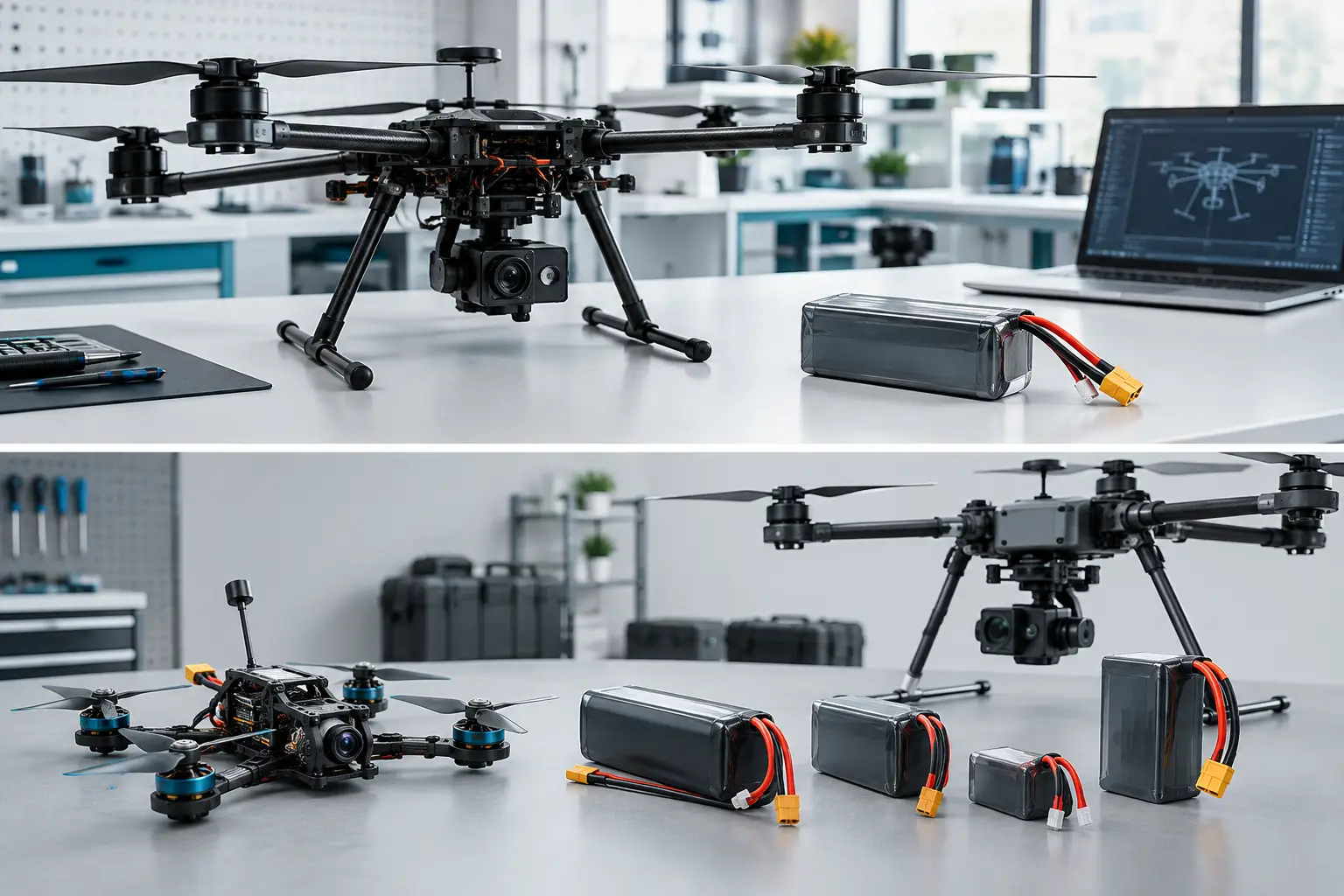
5. Battery Dimensions, Weight, and Connector Compatibility
Electrical performance is only part of battery selection. A battery must also fit the aircraft and connect reliably to its power system.
Before choosing a battery, confirm:
- Maximum length, width, and height
- Maximum permitted battery weight
- Connector type and current requirements
- Wire gauge and cable length
- Mounting method and vibration resistance
- Cable exit direction and available clearance
For OEM drone manufacturers, these details are particularly important during product development. A battery that meets the electrical specifications but does not fit the battery compartment may require costly mechanical redesign.
If standard battery dimensions do not meet your requirements, discuss a customized pack configuration with your battery manufacturer.
6. Internal Resistance, Voltage Sag, and Thermal Performance
A battery’s real-world performance cannot be evaluated by its rated capacity and C-rating alone.
Internal resistance contributes to voltage drop and heat generation when current flows through the battery. Under high loads, excessive voltage sag may affect available motor power and system performance.
For engineering evaluation, consider:
- Internal resistance and cell-to-cell consistency
- Voltage behavior under representative loads
- Temperature rise during discharge
- Performance at expected operating temperatures
- Capacity retention after repeated cycling
A useful evaluation should reflect the intended application. A short burst-discharge test, for example, does not necessarily establish suitability for a long-duration continuous load.
For demanding UAV and FPV applications, request test data that corresponds as closely as possible to your actual operating conditions.
7. Customization and Long-Term Supply Capability
Standard batteries are a practical choice when their specifications match the application. However, drone manufacturers often have specific requirements that are difficult to satisfy with off-the-shelf products.
These may include:
- Special voltage and capacity combinations
- Higher discharge capability
- Strict dimensional and weight limits
- Customized connectors and cable layouts
- Different pack structures for specific aircraft
- OEM/ODM manufacturing and recurring production requirements
When evaluating a battery manufacturer, consider more than the initial unit price. Engineering communication, sample evaluation, specification consistency, production capability, and long-term supply planning can all affect the success of your project.
A technically suitable battery that can be produced consistently is often more valuable than a specification sheet that looks impressive but does not reflect the final application.
How to Select the Right Battery for Your Drone Project
There is no single LiPo battery that is ideal for every drone. The right choice depends on the aircraft design, mission profile, power requirements, and operating environment.
Before requesting a quotation, prepare the following information:
- Application: FPV racing, industrial UAV, agricultural drone, RC aircraft, or another use.
- Voltage: Required cell count or operating-voltage range.
- Capacity: Target capacity or required mission duration.
- Discharge requirements: Continuous current, peak current, and peak duration.
- Dimensions and weight: Maximum available installation space and battery mass.
- Connection requirements: Connector type, cable length, and any special configuration.
- Estimated order quantity: Expected sample, pilot, and production quantities.
The more clearly these requirements are defined, the easier it is to identify a suitable battery and evaluate its performance.
Looking for a LiPo Battery Manufacturer for Your Next UAV or FPV Project?
Leopard Power specializes in lithium battery development and manufacturing, with product categories covering high-rate LiPo batteries, FPV racing batteries, flight batteries, RC batteries, and high-energy-density battery solutions.
Established in 1998, Leopard Power supports customers seeking battery solutions for demanding applications, including UAVs, FPV drones, and RC models.
Whether you are developing a new aircraft, optimizing an existing battery configuration, or evaluating a new supply partner, our team can help assess your requirements and discuss suitable standard or customized solutions.
Have a battery project in development?
Contact Leopard Power with your voltage, capacity, discharge requirements, dimensions, and estimated quantity. Our team can help you evaluate the next steps for your application.
Request a Quote for Your Drone Battery Project