Industrial Drone Battery: How to Balance Capacity, Discharge Rate, and Energy Density
Industrial drones are widely used in agriculture, logistics, infrastructure inspection, surveying, and other professional applications. As UAV platforms become more capable and carry increasingly complex payloads, battery performance plays an important role in determining flight endurance, power delivery, and overall operational efficiency.
For UAV manufacturers, selecting the right battery is not simply a matter of choosing the largest capacity or the highest discharge rate. Battery capacity, discharge capability, energy density, weight, and electrical compatibility must all be considered.
So, how can drone manufacturers find the right balance?
In this article, we explore three important battery performance parameters and explain how they influence UAV battery selection.
1. Understanding UAV Battery Capacity
Battery capacity indicates the amount of electrical charge a battery can store. It is commonly expressed in amp-hours (Ah) or milliamp-hours (mAh).
For example:
– 10,000mAh = 10Ah
– 20,000mAh = 20Ah
– 30,000mAh = 30Ah
However, capacity alone does not describe the total energy stored in a battery. Voltage must also be considered.
The nominal energy of a battery can be estimated using:
Nominal Energy (Wh) = Nominal Voltage (V) × Capacity (Ah)
For example, a battery with a nominal voltage of 22.2V and a capacity of 30Ah has a nominal energy of:
22.2V × 30Ah = 666Wh
A higher-capacity battery can provide more stored charge at the same voltage. However, actual flight endurance also depends on aircraft weight, motor and propeller efficiency, payload, flight speed, environmental conditions, and power consumption.
Therefore, increasing battery capacity does not necessarily result in a proportional increase in flight time.
2. What Is Battery Discharge Rate?
Battery discharge rate is commonly expressed as a C rating. It indicates the current delivery capability relative to the battery’s rated capacity.
A simplified theoretical calculation is:
Theoretical Current (A) = Capacity (Ah) × C Rating
For example, a 20Ah battery rated at 5C corresponds to a theoretical current of:
20Ah × 5C = 100A
However, this calculation should not be treated as a guaranteed operating current. Actual allowable current depends on the manufacturer’s specifications, cell characteristics, battery construction, temperature, and thermal conditions.
Two discharge specifications are particularly important:
Continuous Discharge Rate
This indicates the current a battery is designed to deliver continuously under specified operating conditions.
Peak Discharge Rate
This refers to a higher current that may be available for a limited period. The permitted duration and operating conditions should be confirmed with the manufacturer.
For industrial UAVs, continuous discharge capability deserves particular attention because the battery must support the aircraft’s normal operating power throughout the mission.
3. Voltage Sag and Internal Resistance: Why They Matter
When a drone motor demands high current, the battery’s terminal voltage may decrease under load. This phenomenon is commonly known as voltage sag.
One of the contributing factors is the battery’s internal resistance.
In simplified terms:
Voltage Drop (V) = Current (A) × Internal Resistance (Ω)
A higher current or greater internal resistance can result in a larger voltage drop.
For UAV applications, excessive voltage sag may affect motor performance and cause the battery voltage to reach the low-voltage protection threshold earlier.
Internal resistance, cell consistency, pack construction, wiring, and connector quality can therefore influence real-world battery performance.
When evaluating a battery for a drone platform, manufacturers should consider not only its nominal voltage and discharge rating, but also its voltage behavior under the expected operating load.
4. Capacity vs. Discharge Rate: What Is the Difference?
Although capacity and discharge rate are closely related, they describe different battery characteristics.
– Capacity indicates how much electrical charge the battery can store.
– Discharge rate indicates how quickly the battery can deliver current relative to its rated capacity.
– Voltage determines the electrical potential supplied to the power system.
– Specific energy describes the amount of energy stored relative to battery mass.
A battery with high capacity but insufficient discharge capability may not meet the aircraft’s power requirements.
Similarly, a battery with a high discharge rating but insufficient energy capacity may not provide the required operating duration.
The appropriate balance depends on the UAV’s electrical architecture and mission profile.
For example, a long-endurance inspection drone may prioritize energy storage and weight efficiency, while a high-performance multirotor may require greater current delivery during acceleration and demanding maneuvers.
The battery should therefore be selected according to the aircraft’s actual power requirements rather than a single specification.
5. Why Energy Density Matters for Drone Batteries
Specific energy, also known as gravimetric energy density, describes how much energy a battery stores relative to its mass. It is commonly expressed in watt-hours per kilogram (Wh/kg).
The calculation is:
Specific Energy (Wh/kg) = Battery Energy (Wh) ÷ Battery Weight (kg)
For UAV manufacturers, specific energy is particularly important because battery weight directly affects the aircraft’s weight budget and payload capacity.
A battery with higher specific energy can provide more stored energy for a given battery weight. Alternatively, it may help reduce battery weight for a given energy requirement.
However, battery weight and energy density should be evaluated at the same level of assembly. Cell-level and complete battery-pack values are not directly interchangeable.
For practical UAV applications, manufacturers should consider the specifications of the complete battery pack rather than relying solely on individual cell specifications.
Specific energy should also be evaluated alongside discharge capability, voltage stability, and operating conditions. A higher Wh/kg value alone does not guarantee better overall UAV performance.
6. How Different UAV Applications Influence Battery Selection
Different UAV applications place different demands on battery systems.
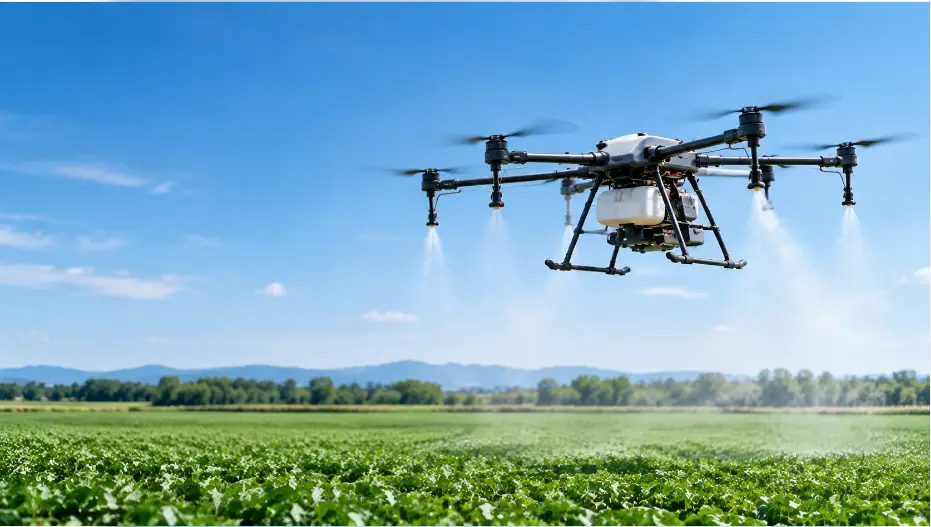
Agricultural Drones
Agricultural drones often carry liquid tanks and spraying equipment. Their payload weight can change throughout a mission as liquid is discharged.
Battery selection should account for takeoff weight, motor power consumption, spraying workload, operating cycles, and required discharge capability.
Industrial Inspection Drones
Inspection drones are used for power lines, bridges, buildings, pipelines, and other infrastructure.
Depending on the aircraft design, these platforms may prioritize stable power delivery, sufficient energy capacity, and predictable operating performance.
Battery weight and dimensions are also important because they affect aircraft integration and payload allowance.
Cargo and Heavy-Lift Drones
Cargo drones are designed to transport heavier payloads and may experience significant power demands during takeoff and climbing.
For these platforms, manufacturers should pay close attention to continuous discharge capability, peak current requirements, battery structure, and thermal performance.
FPV and High-Performance Drones
FPV drones and other high-performance multirotors often require rapid current delivery during acceleration and aggressive maneuvers.
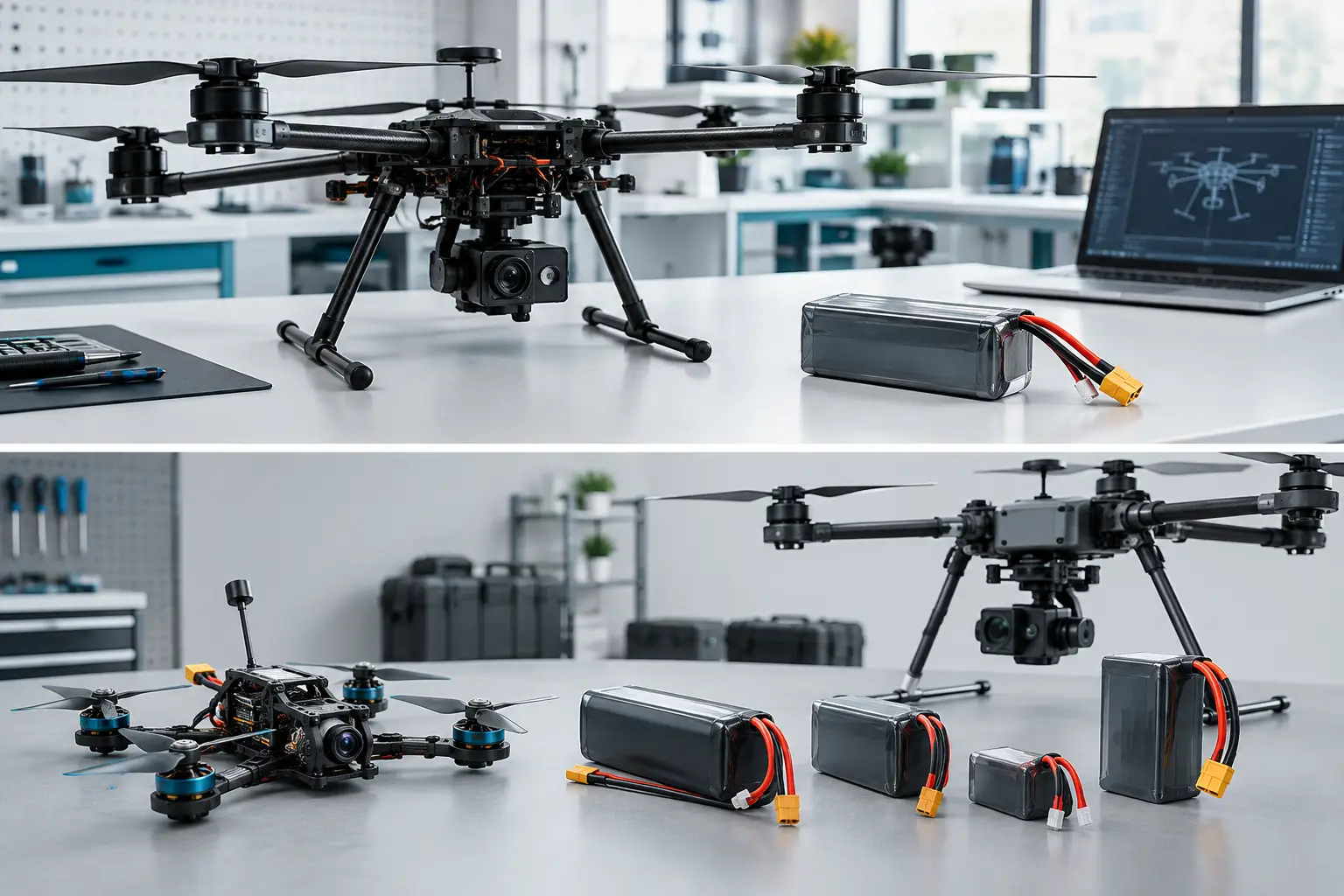
High-discharge LiPo batteries are commonly used in these applications. The appropriate capacity and discharge rating should be determined by the motor system, expected current consumption, and intended flight profile.
7. Key Factors in UAV Battery Selection and Customization
Standard battery specifications do not always meet the requirements of a specific drone platform.
For UAV manufacturers developing a new aircraft, battery selection should be considered early in the engineering process.
Important parameters include:
– Voltage: Must be compatible with the aircraft’s power system.
– Capacity: Should provide sufficient energy for the intended mission.
– Discharge capability: Must support the continuous and peak current requirements.
– Energy density: Should be considered in relation to the aircraft’s weight requirements.
– Dimensions: Must fit the available battery compartment.
– Weight: Must be considered as part of the aircraft’s total takeoff weight.
– Connectors and wiring: Must match the electrical interface and current requirements.
– Operating conditions: Temperature, vibration, and thermal management should be considered.
Choosing a suitable battery configuration requires balancing these factors rather than focusing on a single specification.
Communication between UAV manufacturers and battery suppliers during the design stage can help identify potential compatibility issues before production.
8. Leopard Power: LiPo Battery Manufacturing for UAV Applications
Leopard Power specializes in LiPo battery manufacturing and operates its own production facility.
We provide LiPo battery solutions for different application requirements, including UAV and other demanding applications.
We understand that selecting the right battery involves more than choosing a capacity or discharge rating. Voltage, weight, dimensions, current requirements, and installation conditions must all be considered.
Based on specific project requirements, we can discuss battery configurations and customization options to support different UAV designs and applications.
Whether you are developing an agricultural drone, industrial multirotor, cargo UAV, or FPV platform, Leopard Power welcomes inquiries about LiPo battery solutions for your project.
9. Conclusion
Selecting the right battery is an important part of UAV system design.
Capacity determines how much electrical charge a battery can store, discharge capability determines how quickly it can deliver current, and specific energy helps engineers evaluate the relationship between stored energy and battery weight.
Rather than maximizing a single parameter, UAV manufacturers should evaluate the complete aircraft requirements and select a battery that balances energy, power, weight, and system compatibility.
Looking for a LiPo battery solution for your UAV project?
Contact Leopard Power to discuss your application requirements and explore suitable battery options.
Leopard Power — Your Battery Manufacturing Partner.