Discover how Leopard Power’s advanced solid-state and high-energy-density LiPo batteries solve key drone operations challenges in extreme cold, high altitude, and heavy-payload scenarios.
As the global low-altitude economy expands into critical sectors like high-altitude inspection, emergency rescue, and long-range cargo delivery, commercial UAVs are being pushed into increasingly challenging environments. Standard lithium-polymer (LiPo) batteries often face severe performance degradation under extreme conditions—such as freezing temperatures or heavy payload demands—limiting mission radius and reliability.
At Leopard Power, we are bridging the gap between high performance and operational durability. Here is how our latest solid-state and high-energy-density battery technologies are reshaping heavy-duty UAV performance in tough conditions.
1. The Cold-Weather Challenge: Maintaining Energy Density Below Zero
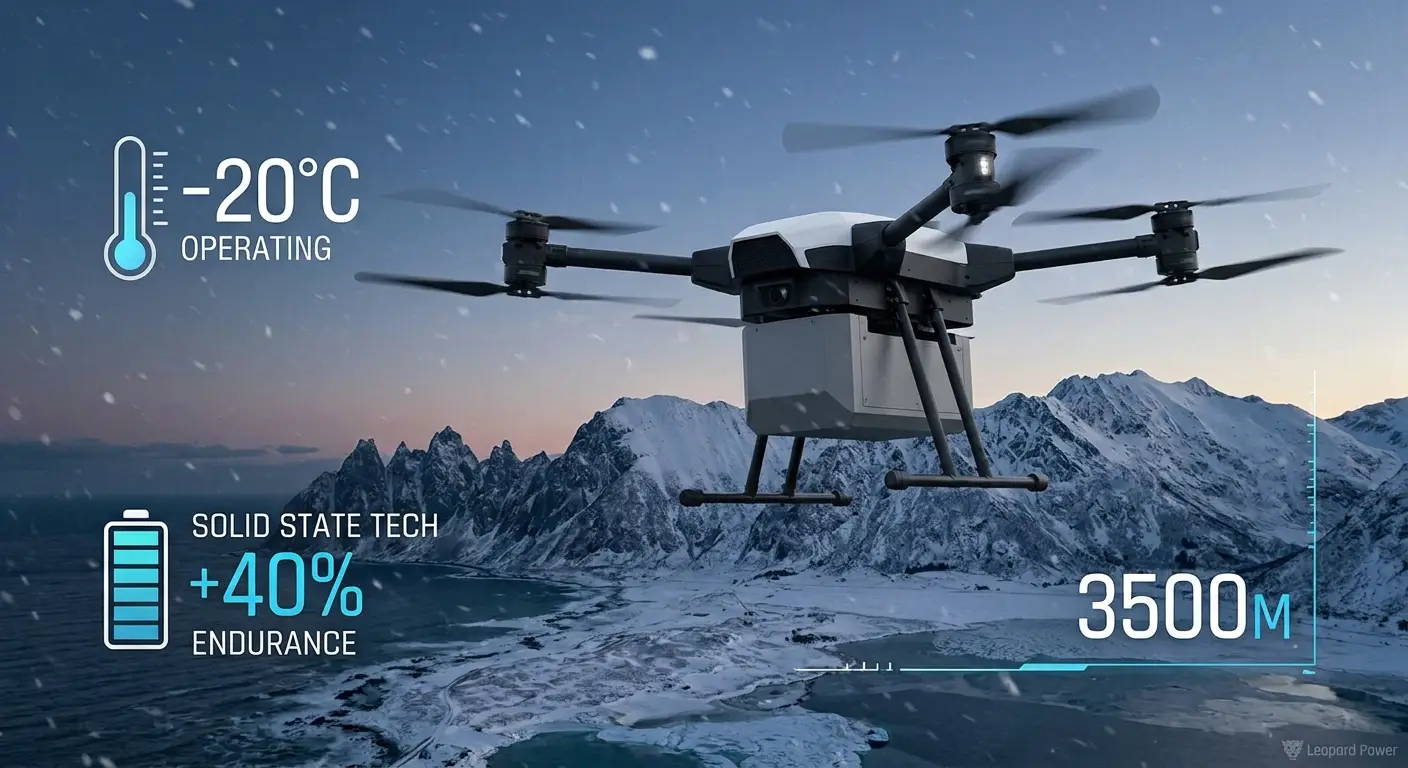 In sub-zero temperatures, conventional liquid electrolyte LiPo batteries experience rapid voltage drops and internal resistance spikes, leading to:
-
Sudden flight-time reduction (up to 30%–50%).
-
Unpredictable cell discharge curves.
-
Increased risk of emergency landings.
The Solid-State Advantage: Leopard Power’s Solid-State Battery Series utilizes stable electrolyte architectures and advanced thermal management design. By maintaining cell integrity and low internal resistance at low temperatures, our high-density packs deliver predictable discharge rates without catastrophic voltage drops, ensuring critical missions are completed safely.
2. Payload vs. Endurance: Breaking the Weight Barrier
For heavy-lift multirotors and agricultural/inspection drones, every extra gram of battery weight directly reduces usable payload capacity.
To solve this trade-off, our engineering team focuses on gravimetric energy density innovation:
-
350Wh/kg to 520Wh/kg Series: Delivers up to 40%–60% more energy capacity compared to traditional 250Wh/kg battery packs at the same weight.
-
Compact Form Factors: Enables drone manufacturers to reduce overall aircraft footprint while increasing operational range.
3. Safe High-C Discharge for Tactical & FPV Operations
For fast-response or specialized maneuvering drones, dynamic power surges require batteries that can handle ultra-high discharge rates (up to 150C–200C) without dangerous thermal runaway.
Leopard Power incorporates custom conductive additives and high-purity materials in our high-rate LiPo and Graphene Si-GR-HV series, offering:
-
Lower Operating Heat Generation: Extends total battery lifespan.
-
Stable High Voltage Platform (HV): Sustains maximum thrust throughout the discharge cycle.
Looking Ahead: Partnering for Custom Power Solutions
Whether you are building next-generation eVTOLs, autonomous delivery drones, or industrial inspection fleets, selecting the right battery configuration is paramount. Leopard Power offers comprehensive OEM/ODM customization services—ranging from custom cell chemistry and BMS integration to pack layout tailored to your drone’s exact specs.
👉 Ready to elevate your UAV system performance? Contact our engineering team today to discuss custom LiPo and Solid-State battery options for your application.